Amanah
Bookkeeping for masjids and Islamic centers

Every dollar your masjid receives, held as an amanah.

Amanah matches every Mohid, Zelle, Zeffy, Venmo and Tap2Pay gift to the bank, keeps Zakat and Sadaqa in their own funds, and closes each month with two signatures. The treasurer, the board and the community can all see where the money went.

The demo is a fictional masjid with twenty months of books. One click, no account.
Home: where the month stands
Amanah's home page: the month's checklist, cash by fund and cash by bank account
Why a masjid needs this

A masjid's books are not a small business's books

General accounting software is built for sales and invoices. A masjid runs on gifts that arrive six ways, money held in trust for others, and volunteers who change every few years.

$

Gifts arrive six ways; the bank sees lumps

Mohid settles each day's gifts in one deposit. Zeffy pays out weekly, Venmo when someone cashes out, Tap2Pay as "Merchant Service". Which donors are inside a $3,495 deposit? Amanah knows.

Zakat and Sadaqa are held in trust

They belong to the people they are for, not to the masjid's running costs. Spending them on the electricity bill, even by accident, breaks the trust the donor placed in you.

Designated gifts land in the wrong account

A donor writes "zakat" on a Zelle that reaches Operations. Venmo cashes out into the building fund. Amanah reads the donor's own words and tells you what to move, and where.

Treasurers are volunteers, and they change

When the books live in one person's spreadsheets, they leave with that person. Amanah keeps the rules, the explanations and the history, so the next treasurer starts where the last one stopped.

?

The board and the community ask

"How much Zakat did we give out? Is giving up this quarter?" The answers should take minutes, not weeks. The general body meeting deck is one click.

Auditors and CPAs want evidence

Every change has a reason, a name and a time, in an audit trail that cannot be quietly edited. Each month is closed by the treasurer and approved by a second signer.

What it does

The month, from bank statement to board report

Every deposit matched to the gifts behind it

Upload the bank statements and the platforms' exports. Amanah matches each deposit to its gifts: Mohid's daily batches, Zeffy's weekly payouts net of fees, each Zelle one to one.

  • Exceptions, not noise. Only what doesn't match is listed: a refund, a deposit with no record, a gift that never reached the bank.
  • Explain once. A note, or a rule that settles every item like it, past and future.
  • Why? An AI reads the evidence and suggests the cause, with donors' names left out.
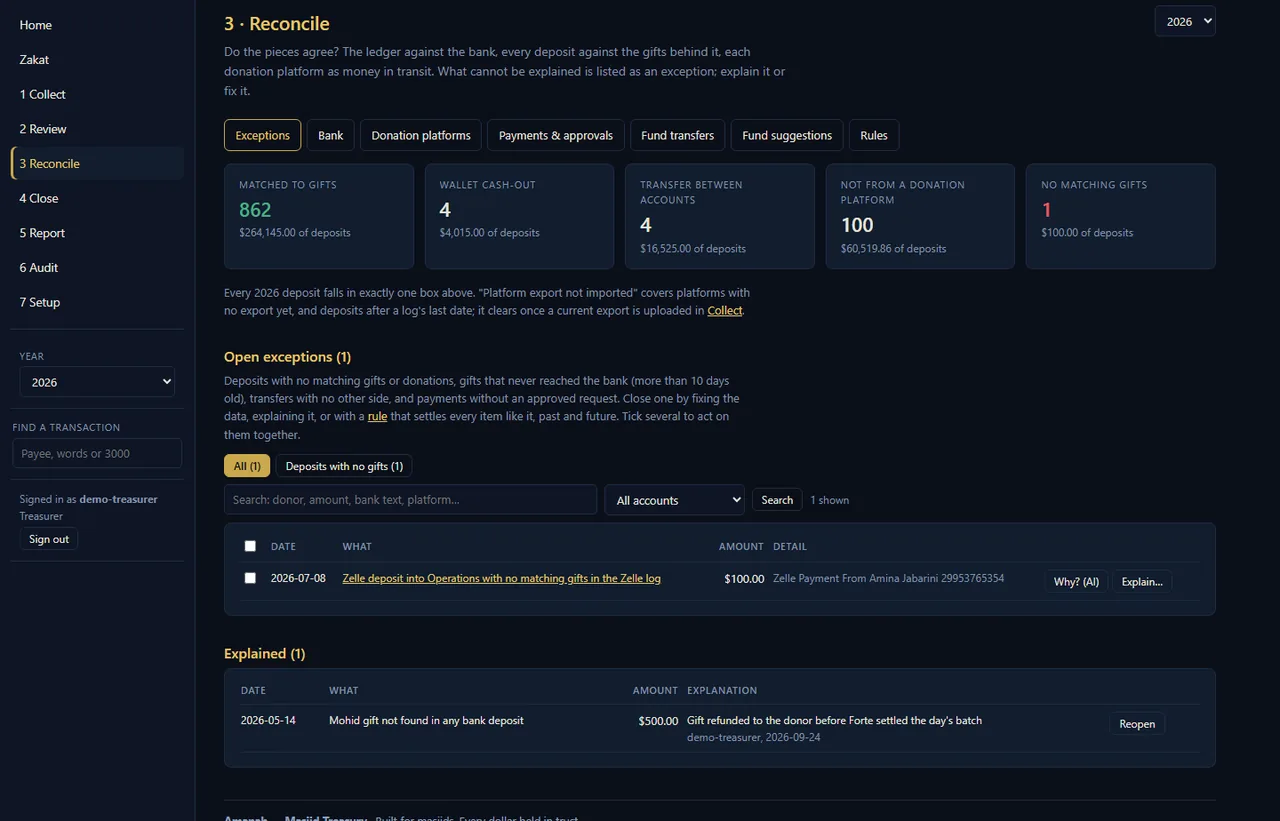
Reconcile · Exceptions
Reconciliation: 862 deposits matched to gifts, one open exception

What to move between accounts, and why

Donor designation rules read what the donor wrote ("zakat", "fitra", "sadaqah") and where the money landed. Amanah sets that against the transfers already made and tells you what is still owed to each fund.

  • Fitra is Zakat, reported on its own line.
  • The gifts behind every amount, downloadable, with the memo to write on the transfer.
  • Your rules: Venmo belongs to Operations, Tap2Pay's "Merchant Service" is a donation.
Reconcile · Fund transfers
Money to move between accounts, with the gifts behind each amount

Close each month with two signatures

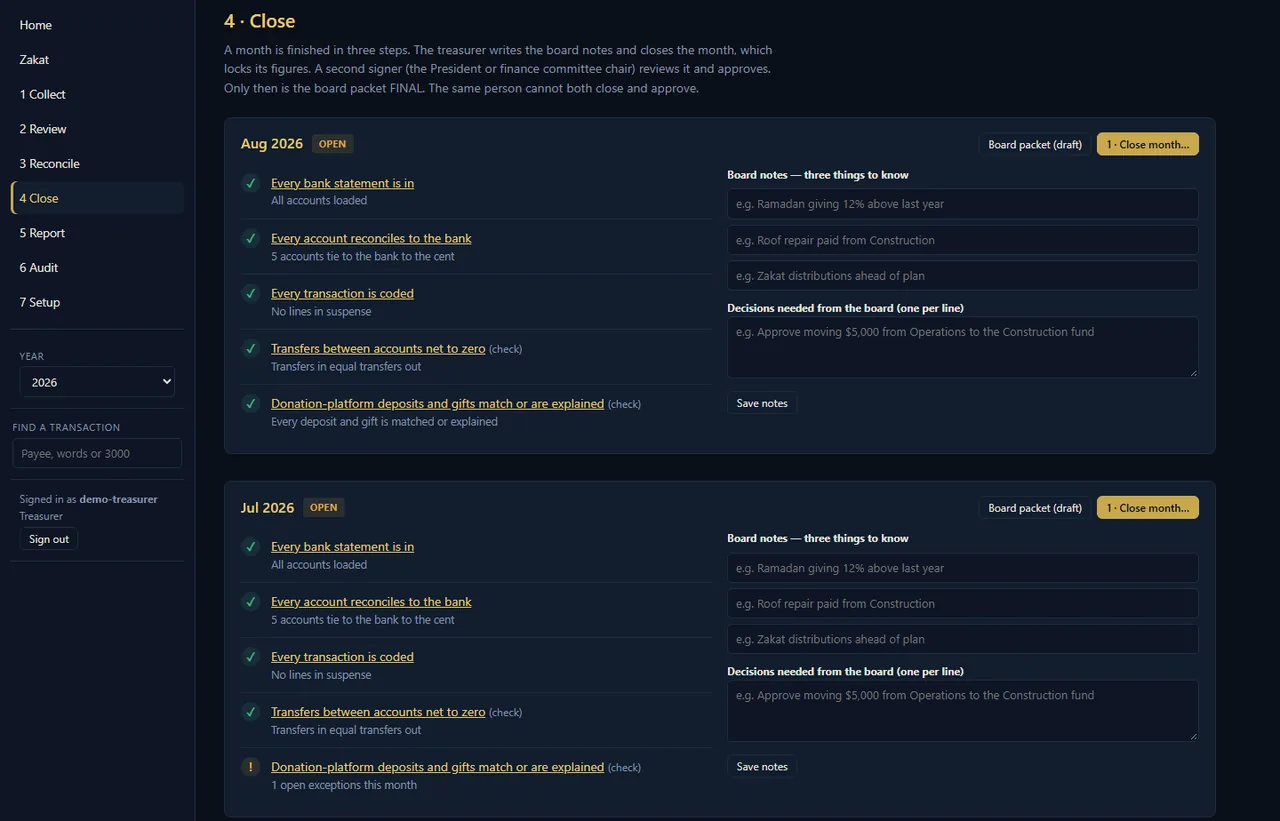
A checklist the data answers for itself: every statement in, every account agreeing with its bank to the cent, everything coded, transfers netting to zero, exceptions dealt with.

  • Board notes: three things to know, and the decisions needed.
  • Separation of duties: the person who closes cannot approve.
  • Locked once approved; reopening needs a reason on the record.
Close
The month-end checklist and board notes

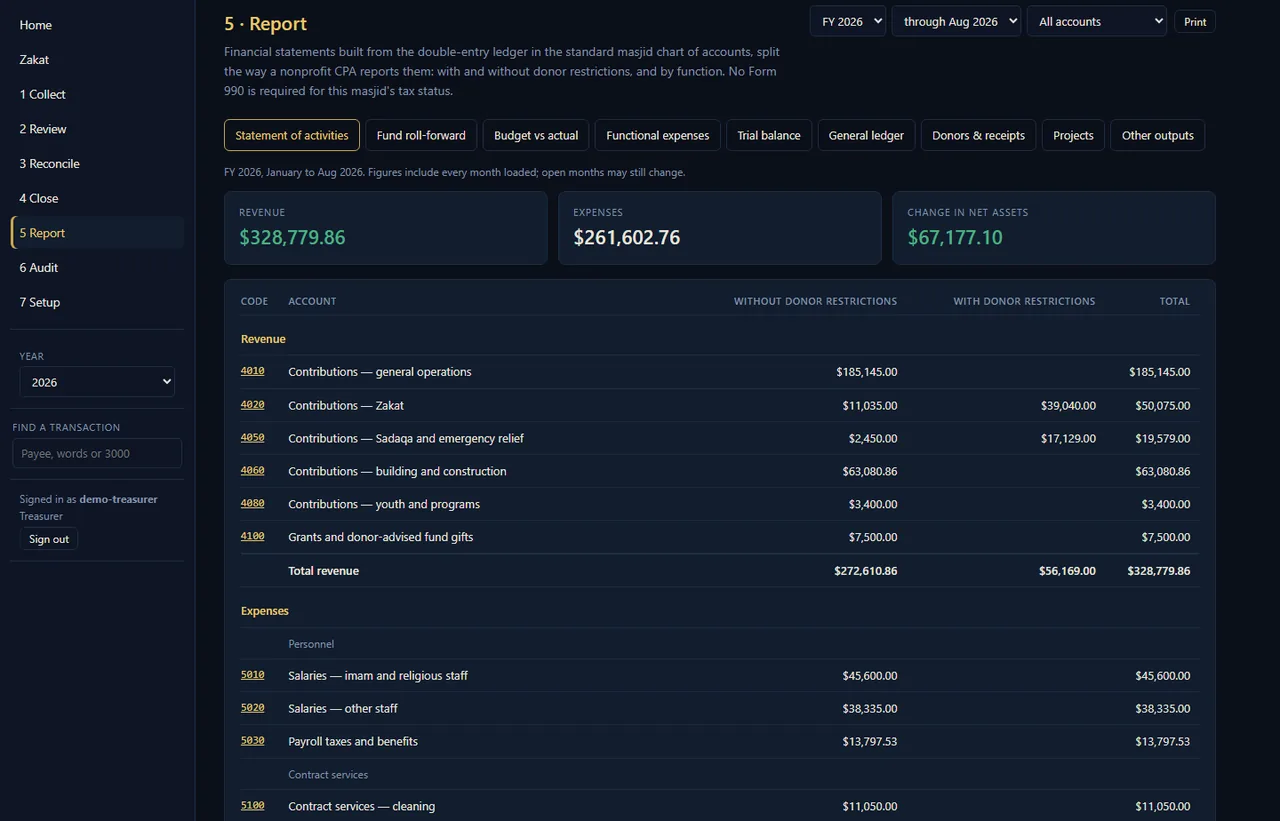
Statements a nonprofit CPA recognises

A double-entry ledger in a standard masjid chart of accounts, reported the way nonprofits report: with and without donor restrictions, and by function.

  • Statement of activities, fund roll-forward, trial balance, general ledger, each line opening the transactions behind it.
  • Budget against actual, functional expenses, donors and year-end receipts.
  • A needs-review workbook for your CPA to answer in Excel; upload it and the answers are applied.
Report · Statement of activities
Statement of activities with and without donor restrictions
Zakat

Zakat, from the donor's hand to the family's

A page of its own for the Zakat fund: what came in, including Zakat that landed in the wrong account; whom it reached; how long the rest has been held; and whether each Ramadan's Fitra was given by Eid.

al-FuqaraThe poor
al-MasakinThe needy
al-AmilinAdministering Zakat
al-Mu'allafaReconciling hearts
fi al-RiqabFreeing from bondage
al-GhariminThose in debt
fi SabilillahIn the cause of Allah
Ibn al-SabilThe stranded traveller
  • The eight categories of at-Tawbah 9:60. The relief committee records each payment's category, with a reason, in the audit trail.
  • Held how long. Unspent Zakat by age, against your masjid's own limit.
  • Fitra by Eid. Each Ramadan's Fitra against what was given out before the Eid prayer.
  • No names. The board sees totals; the report names no one who received Zakat.

Amanah records your masjid's decisions. It doesn't make rulings: which payments qualify, and how long Zakat may be held, are for your imam and scholars.

Zakat
The Zakat page: the fund, whom it reached, how long it has been held, Fitra by Eid
The general body meeting

The quarter, ready for the community

Choose the months and Amanah makes the deck: giving against last quarter by platform, the funds held in trust, spending by account with the detail behind it, and every bank balance. Families helped and staff are never named.

Slide: the quarter at a glance Slide: donations by source Slide: funds held in trust
How it works

Three steps a month

Collect

Upload each account's bank statement as downloaded, and the exports from Mohid, Zeffy, Zelle, Venmo and the rest. Nothing to retype.

Review and reconcile

Lines are coded by your rules. Deposits are matched to their gifts. You deal only with what doesn't fit, and see what to move between funds.

Close and report

The treasurer closes, a second signer approves, and the board packet, statements and GBM deck are ready.

TreasurerRuns the month, closes it, sets things up.
BookkeeperUploads, codes and reconciles; cannot close.
Second signerReviews and approves each closed month.
BoardReports and the close status; no donor names.
Relief committeeRecords whom Zakat reached.
CPAReads everything, changes nothing.
Security and privacy

Donor and family information deserves care

What Amanah does today. We describe only what is true.

Two-factor sign-in for everyoneA password and an authenticator code. Repeated failures lock the account for a while.
Roles that the software enforcesThe board never sees donor names; the CPA cannot change anything.
Encrypted in transitHTTPS only, with modern TLS and HSTS.
A tamper-evident audit trailEvery change, with who, when and why, chained so an edit shows.
Encrypted backups, nightlyReadable only with a key your masjid holds, not the server.
Your data is yoursExport all of it at any time. Never sold, never shared.
AI only if you want itAI help is off unless you turn it on. When it explains an exception, donors' names are removed first.
One masjid per installationEach masjid's books live in their own, separate installation.
Questions

Asked by treasurers

Do we need to change banks or donation platforms?

No. Amanah reads the PDF statements your bank already gives you and the exports your platforms already offer: Mohid, Zelle, Zeffy, Venmo, PayPal, Stripe and Tap2Pay. During the pilot we add your bank's statement format if it isn't read yet.

We already use QuickBooks. Why switch?

QuickBooks doesn't know which donors are inside a Mohid deposit, that a Zelle marked "zakat" belongs to the Zakat fund, or that Fitra must be given by Eid. Amanah does the masjid-specific work and keeps a standard chart of accounts your CPA recognises.

Can the board see who gave what?

No. The board sees the reports and the close status, never donor names or bank descriptions. Families who received Zakat or Sadaqa are never named in reports or decks.

Is Amanah giving religious rulings?

No. It records the decisions your masjid makes: the category of each Zakat payment, your holding limit, your Eid date. The rulings are for your imam and scholars.

What does it cost?

The pilot is free for the first masjids, in return for feedback. Pricing afterwards will be a simple monthly fee sized for masjid budgets.

Who is behind Amanah?

A serving masjid treasurer, who built it to keep a real masjid's books: reconciling its platforms, closing its months and preparing its general body meetings.

Can we leave with our data?

Yes, at any time: the books, the rules, the audit trail and the reports, as files you keep.

Join the pilot

We are setting up a small number of masjids, one at a time, alongside their treasurer. Bring a year of statements and your platform exports, and see your own books reconciled.

Write to us → Explore the demo first
  • Set up with you, not left to a manual
  • Your bank and platforms read from day one
  • Your chart, funds, roles and rules in place
  • Free during the pilot